What is USDS?
- Getting Started
- 8 min read
- June 12, 2026


Key takeaways
- USDS is the native stablecoin of Sky Protocol, issued through the protocol and governed by SKY token holders, with backing verifiable onchain anytime.
- USDS is the capital Sky Agents borrow from Sky Protocol and compete to deploy into yield-generating strategies, producing the largest share of the protocol revenue behind the Sky Savings Rate.
- The Peg Stability Module holds the peg in both directions: 1:1.
- Every USDS is backed by Protocol Collateral worth more than the USDS in circulation.
- USDS is the third-largest stablecoin in the world, with supply growing 74% in 2025.
- USDS does not generate yield on its own; it is the entry point to sUSDS and the Sky Savings Rate through Sky.money.
Most stablecoins are built to move value. Any stablecoin in the market is good at that. You can transfer dollars globally, your transactions settle instantly, and you pay minimal fees. But moving value is a point-in-time act. Once your transfer lands, nothing else happens at the protocol level to make the most of your idle stablecoins. USDS is built for something different than just transferring value.
USDS is the native stablecoin of Sky Protocol. It’s the capital through which Sky Agents borrow from Sky Protocol and compete to deploy into yield-generating strategies. The returns build the diversified yield base that Sky Governance uses to calibrate the Sky Savings Rate. And it’s built to convert 1:1 from the stablecoins you already hold like USDT and USDC.
USDS is issued through Sky Protocol and governed by SKY token holders. The Protocol Collateral that backs it is onchain and verifiable in real time at financial.skyeco.com. You don’t have to take anyone's word for it.
How USDS holds its peg
USDS targets $1.00, and there’s two separate systems that do that work: active market mechanisms that push the price back to par whenever it deviates, and the Protocol Collateral structure that ensures every USDS in circulation is backed. They are related but distinct, and understanding both is how you evaluate the stablecoin.
The Peg Stability Module
The Peg Stability Module (PSM) is the core of the USDS peg. It's a smart contract that lets anyone swap between USDS and USDC at exactly 1:1, in either direction. Swap fees in both directions are currently set to zero by Sky Governance, and the contract maintains a pool of pre-minted liquidity so trades clear instantly, without waiting on a mint.
This design removes coordination from peg defense, as in: no one has to organize it, it happens automatically. If USDS trades at any discount on the open market, buying it and redeeming through the PSM at full face value captures whatever spread may exist. That trade fires the moment a deviation appears and repeats until the price returns to par.
Under the hood, the PSM is itself a vault inside Sky Protocol, with one distinctive feature: it operates at a 100% collateralization ratio with no fee on the USDS it issues. Every swap is fully backed, and the exposure the PSM can take to its collateral is capped by a governance-set ceiling. At the time of writing, the PSM holds roughly $4.12B in stablecoin liquidity, which means swaps clear at scale: large allocators can move size in and out of USDS without moving the price. Current PSM balance, along with every other asset backing USDS, is auditable at auditable in the Sky Protocol financial dashboard.
The ceiling
The PSM works in both directions, so the same contract that holds the floor also holds the ceiling. When market demand pushes USDS above the $1.00 target, anyone can mint new USDS through the PSM at exactly 1:1 against USDC and potentially sell it at the premium. New supply enters the market until the premium closes, through the same arbitrage that defends the floor.
Overcollateralized vaults add a second force in the same direction. Vault users can mint new USDS against their collateral and choose to sell it while the price sits above par. That minting is the slower force: it requires posting more than a dollar of collateral per USDS and carries an ongoing fee set by Sky Governance. The PSM is the hard edge on both sides of the peg; vault minting reinforces it.
The liquidation system
Overcollateralized vaults are the third leg. Every vault must hold collateral worth more than the USDS minted against it. If a borrower's collateral value falls below the liquidation threshold, the vault goes to an automated auction, and the debt is repaid from auction proceeds before any loss can reach the rest of the system. Decentralized oracle price feeds provide the real-time collateral valuations the system runs on.
Sky Protocol has operated this liquidation infrastructure for more than seven years, through Black Thursday in 2020, the 2022 bear market, and every major liquidation cycle since, without a core protocol exploit. The parameters that govern it, from collateralization ratios to auction mechanics, are set by Sky Governance and visible onchain.
Protocol Collateral
Every USDS in circulation is a Protocol Obligation: a redeemable claim. The collateral is diversified across eight categories:
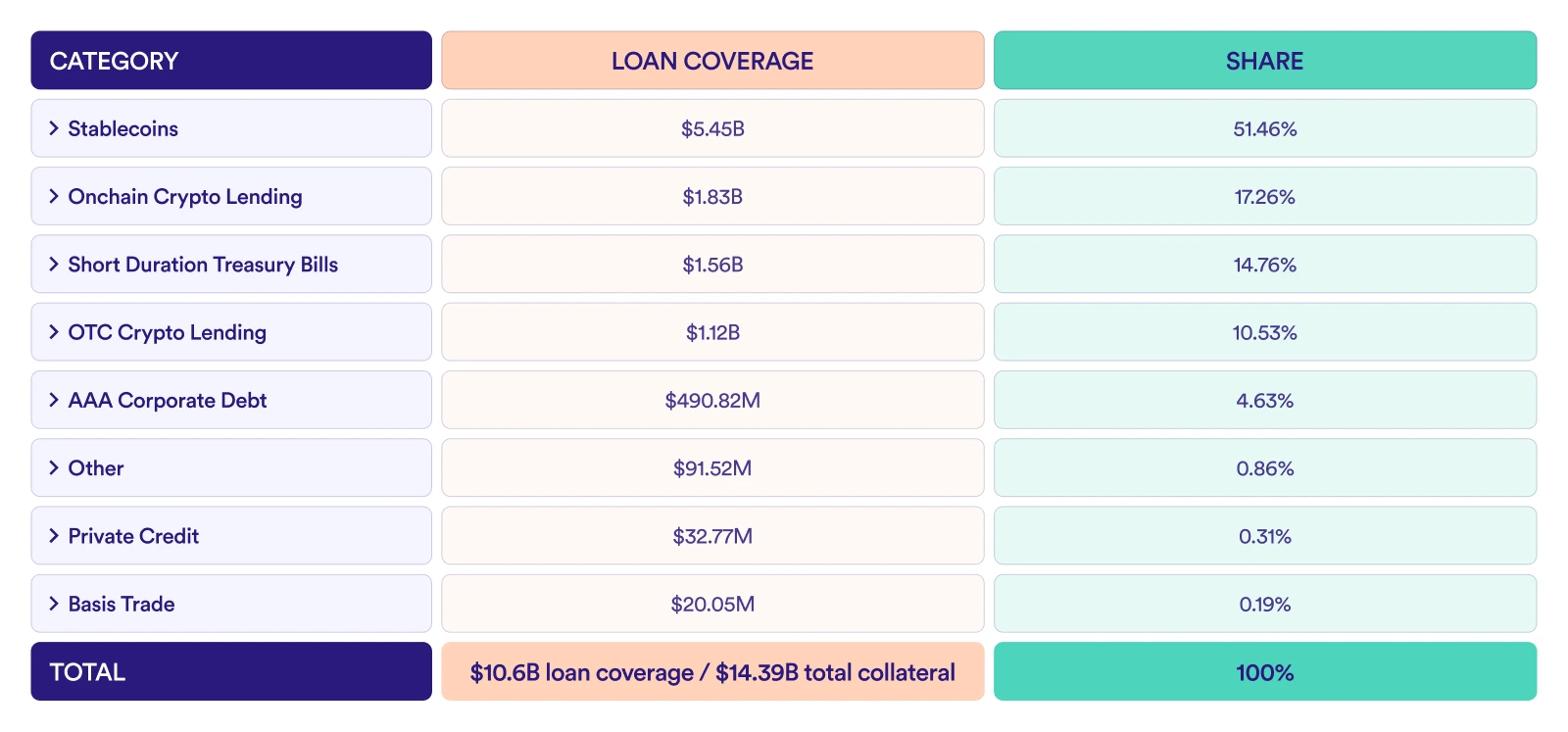
Stablecoins: The largest component. Stablecoins including USDC, USDT, and PYUSD, held across PSM structures, lending protocols, and liquidity positions deployed through Sky Agents. The current breakdown by position is auditable at financial.skyeco.com.
Onchain Crypto Lending: USDS deployed through onchain lending structures under governance-set risk parameters. Overcollateralized positions with automated liquidation infrastructure.
Short Duration Treasury Bills: Sky Agents deploying into US Treasury bills, not direct protocol exposure. Adds duration-matched, institutional-grade backing to the collateral stack.
OTC Crypto Lending: Crypto lending through over-the-counter structures, governed by the same risk framework as onchain positions.
AAA Corporate Debt: High-grade corporate debt positions. Part of the diversification layer that structurally reduces dependence on a single asset class.
Other: Smaller positions across onchain credit, basis trade structures, and other approved collateral types.
Protocol Collateral is designed to exceed Protocol Obligations at all times. The current total collateral of $14.39B against $10.6B in loan coverage reflects the structural overcollateralization the system maintains.
Why USDS is a credible foundation
USDS is the third-largest stablecoin in the world, with its supply growing 74% in 2025.
The team behind Sky Protocol has been operating the same core infrastructural approach for nearly a decade since MakerDAO and DAI. That operating period covers Black Thursday, the UST collapse, FTX, and SVB. Across all that, the technical backing and disciplines that make up Sky Protocol today haven’t experienced a single core protocol exploit.
The Protocol Collateral backing USDS is onchain and verifiable at any time. There is no quarterly audit to wait for (even though the Sky Frontier Foundation does publish those as well), and no centralized custodian to trust.
Recognized in the Fortune Crypto 100
Fortune published the Fortune Crypto 100, its ranking of the most influential companies in blockchain, built on data analysis by Inca Digital and a survey of leading industry experts. Sky Protocol was mentioned in the Stablecoins category: USDS ranks third in the world, after Tether and Circle.
Common questions
What's the difference between USDS and USDC or USDT?
Does USDS generate yield on its own?
Can I convert USDS back to my original stablecoin?
How is USDS backed?
Is there a fee to convert to USDS?
About this blog
The Sky.money blog will cover how Sky Protocol mechanics are made available through the Sky.money interface, how Sky Governance votes shape the protocol's risk posture, why broadening Sky Protocol's reach through integration partners matters for the rate you earn, and what all of that means for your own stablecoin strategy.